Stainless steel brazing unlocks amazing possibilities for joining metal in everyday life and industry. You see stainless steel everywhere—in kitchen sinks, medical tools, car parts, and building designs. Why? It resists rust, stays strong under pressure, and looks sleek.
But connecting it through welding can be a real headache. Traditional methods like fusion welding often cause warping or damage that weakens its corrosion resistance. This frustrates DIYers and pros alike.
That’s where brazing shines as a smarter solution. It works at lower temperatures to bond stainless steel firmly and neatly. Brazing keeps the base metal intact, avoiding those pesky problems. You achieve tough, long-lasting joints while keeping key properties intact. Sounds great, right?
This guide makes it all easy to grasp. I’ll walk you through the basics, tools, and hands-on tips. Whether you’re fixing a leaky faucet at home or diving into industrial projects, you’ll master stainless steel brazing step by step. Let’s get started on this journey to better connections!
Stainless Steel Brazing Principles
Before picking up your torch or choosing materials, let’s quickly cover how brazing actually joins stainless steel. It’s not magic—it’s simple science working under the flame. Mastering these fundamentals is key to strong, reliable joints every time. Here’s the breakdown:
What is Stainless Steel Brazing
Stainless steel brazing joins metal using a simple but brilliant process. We melt a special filler metal (called brazing alloy) that has a lower melting point than the stainless steel itself.
Once molten, this filler flows into the tiny gap between the parts you’re joining. It doesn’t just sit there—it actually bonds with the stainless steel on an atomic level.
Picture it as a metal adhesive bonding securely to the parent material. The result? A strong, seamless connection without melting the original stainless pieces.
Key Elements
Three critical factors make this magic happen:
Temperature Control: You must heat the joint above the filler metal’s melting point but stay below stainless steel’s melting temperature. This sweet spot keeps your base metal solid while letting the filler flow freely.
Capillary Action: This is nature’s helper! Molten filler metal gets pulled into tight joint gaps (like water soaking into a paper towel) without needing force. That’s why clean, closely fitted joints work best.
Metallurgical Bond: Unlike glue that just sticks surfaces together, brazing creates true metal fusion. The molten filler dissolves a tiny bit of the stainless steel surface, and stainless steel atoms mix into the filler. When it cools, you get a single, unified metallic structure—not just a surface bond.
Essential Helper: Flux
The rust-fighting chromium oxide layer on stainless steel stops brazing filler from bonding properly. That slick surface won’t let the molten metal “wet” or spread. Flux solves this problem. Apply this paste or liquid before heating. As temperatures rise:
- Flux Cleans: It chemically dissolves that stubborn oxide layer, exposing raw stainless steel.
- Flux Protects: It forms a liquid shield, preventing new oxides from forming during heating.
- Flux Enables Flow: With oxides gone, the molten filler can properly wet the surface and spread via capillary action.
Without flux, your filler will bead up like water on wax instead of flowing into the joint. Always match your flux to your specific brazing alloy and stainless type. Now that we’ve covered the science, let’s explore the tools and methods that put these principles into action!
Learn how to choose brazing flux.
How to braze stainless steel: Different methods and steps
Stainless steel brazing isn’t one-size-fits-all. The ideal approach varies by your project’s size, accuracy demands, and cost. Three primary techniques dominate: the versatile Oxy-Fuel Torch, the high-precision Induction Brazing, and the production powerhouse Furnace Brazing. Let’s break down each workhorse, starting with the most accessible option.
Torch Brazing Stainless Steel
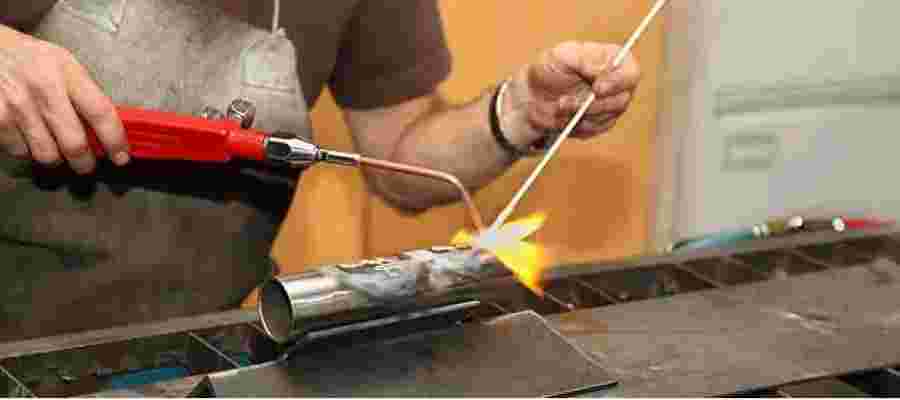
When your stainless sink springs a leak or a railing joint fails, oxy-fuel torch brazing is your on-the-spot repair hero. Much like a reliable Swiss Army knife, it’s the top adaptable solution for stainless steel in practical situations, though this finicky metal needs special handling. Here’s how to wield it effectively:
Tools You’ll Need:
- Oxygen and fuel gas cylinders (acetylene/propane)
- torch with small
- precise tips (critical for stainless heat control)
- stainless-specific flux (paste or liquid)
- heat-resistant gloves
- #5 shaded goggles for cherry-red visibility
How It Works:
- Prep is Paramount: Grind joints to bare metal – stainless oxide resists wetting!
- Flux First: Coat the joint area heavily with stainless-grade flux to attack chromium oxide.
- Neutral Flame Only: Adjust to a soft, hiss-free flame. Oxidizing flames destroy corrosion resistance!
- Broad Preheat: Sweep the flame around (not directly on) the joint – stainless conducts heat poorly.Aim for uniform dull red (650-750°C).
- Targeted Fill: Touch filler rod to joint edge—capillary action should suck it in. Overheating = blue tints & weakened metal!
Key Advantages
- Low entry cost—basic kits are affordable
- Mobility—ideal for on-site fixes or cramped areas
- Fast heat-up—gets the job done quickly
- Forging—works on complex/shaped parts
Disadvantages
- Skill-dependent—heat control takes practice (overheat = damaged metal)
- Wider heat zone—can distort thin sections
- Fire risk—demands strict gas/flame discipline
Applications:
Pipe repairs, railings, DIY projects (like fixing that leaky sink), and on-site fabrication where portability trumps perfection.
“The torch is where most brazers cut their teeth—affordable and adaptable, but mastering it demands respect for the flame.”
Next, we’ll explore another brazing method – induction brazing. Precision meets speed with induction brazing—the secret behind flawless medical implants and turbocharger parts.
Induction Brazing Stainless Steel
For brazing stainless steel that requires flawless precision—zero distortion, perfect consistency, and exact accuracy – induction is frequently the go-to method. This electromagnetic method excels where stainless steel’s sensitivity to heat becomes its biggest challenge. Let’s see why it’s a game-changer:
Tools You’ll Need:
- Induction power generator
- custom copper coil (designed for your specific stainless steel part)
- non-conductive ceramic fixtures.
How It Works with Stainless Steel:
Place your pre-assembled stainless steel components (with filler pre-placed) into the coil. High-frequency current in the coil creates a magnetic field. This field induces powerful eddy currents within the stainless steel itself.
Crucially, stainless steel’s electrical resistance causes it to heat rapidly—from the inside out. The joint reaches brazing temperature in seconds, melting the filler precisely where needed, while the bulk metal stays remarkably cool.
Advantages of Induction Brazing Stainless Steel
- Minimal Heat-Affected Zone: Targeted heating maintains the stainless steel’s corrosion resistance, since it avoids chromium carbide formation in nearby metal—an issue common with slower techniques.
- Zero Warping Guarantee: Thin stainless sheets, tubes, and delicate assemblies stay perfectly true—vital for medical tools and sensors.
- Better Oxide Control: Faster heating reduces the chance of surface oxidation. When combined with an inert atmosphere or specialized pastes, this allows for excellent wetting.
- Speed & Repeatability: Achieve hundreds of identical, high-strength joints per hour—perfect for automotive turbocharger parts or valve assemblies.
- Clean & Efficient: Minimal flux needed, no open flame, energy focused only on the joint.
Disadvantages of Induction Brazing Stainless Steel
- Investment Matters: Equipment and custom coil costs are significant (but pay off fast in volume).
- Design is Key: Coils must match part geometry perfectly for even heating—prototyping is essential.
- Material Sensitivity: Optimal settings vary by stainless grade (304 vs. 316 vs. 17-4PH).
Applications:
Medical implants & instruments, aerospace fuel lines, automotive exhaust sensors & turbo components, electronics hermetic seals, and any high-volume production where precision, corrosion integrity, and zero distortion are non-negotiable.
Furnace Brazing Stainless Steel
When stainless steel assemblies demand absolute perfection across thousands of identical parts—think spacecraft fuel lines or implantable medical devices—furnace brazing is the undisputed maestro. This controlled, batch-processing method solves stainless steel’s toughest challenges through precision engineering.
Tools You’ll Need:
- Specialized brazing furnace (vacuum or inert gas atmosphere)
- custom fixtures to hold assemblies
- stainless-specific filler preforms (exact shapes/quantities)
- automated loading systems.
How It Works with Stainless Steel:
- Assemble Clean: Parts are meticulously cleaned and fitted with pre-placed filler metal.
- Seal & Protect: Load assemblies into the furnace chamber. Purge with argon/hydrogen or pull vacuum.
- Precision Cycle: Programmed heating ramps precisely control temperature (avoiding sensitization). An inert/vacuum environment prevents oxidation—no flux needed!
- Controlled Cool: Slow cooling minimizes thermal stress, preserving stainless steel’s corrosion integrity.
Advantages of Furnace Brazing Stainless Steel:
- Zero Oxidation Perfection: Vacuum/inert gas eliminates chromium oxide formation, enabling flawless wetting on complex joints.
- Batch Consistency: Hundreds of identical assemblies brazed simultaneously with NASA-level repeatability.
- Complexity Mastered: Seals intricate, multi-point joints inaccessible to torches or coils (e.g., honeycomb aerospace structures).
- Keeps Corrosion Resistance: Temperature control stops carbide formation and warping.
- Surface Pristine: No flux residue, no cleanup, no contamination – critical for medical/optical parts.
Disadvantages of Furnace Brazing Stainless Steel:
- High-Cost Equipment: Multi-million-dollar furnaces demand mass production to pay off.
- Lead Time Costs: Hours-long cycles make small batches or repairs impractical.
- Fixture Challenge: Tooling must tolerate high heat while keeping stainless surfaces contamination-free.
Applications:
Essential for aerospace engine parts, satellite fuel systems, and nuclear instrumentation; crucial for medical devices like pacemakers and luxury watches. All require flawless consistency, zero defects, and superior corrosion resistance.
Troubleshooting Stainless Steel Brazing
Even with the right tools and technique, stainless steel can throw curveballs during brazing. Don’t get discouraged – these issues have practical solutions! Let’s break down four frequent problems, their root causes, and how to overcome them for flawless joints. Understanding these will transform frustration into confidence at the torch or coil.
Filler Metal Not Spreading
Nothing’s more frustrating than your brazing filler balling up instead of flowing. For stainless steel, this usually stems from four culprits:
- First, insufficient heat—stainless needs precise temperature control. Too low, and the filler won’t melt properly.
- Second, contaminated surfaces—oils, grease, or even fingerprints block bonding.
- Third, weak or old flux—stainless steel’s tough oxide layer demands fresh, active flux.
- Finally, incomplete oxide removal—that invisible chromium barrier must be fully broken down.
Here’s the fix: Double-check your temperature with a temp stick or infrared gun. Clean joints immediately before brazing using stainless steel wire brush or acetone. Always use flux designed for stainless within its shelf life. If filler still beads, gently scrape the joint with a flux-dipped rod while heating to disrupt stubborn oxides.
Porosity and Slag
Those pesky holes or debris pockets weaken joints dramatically. For stainless projects, watch for:

- Poor gap design—too wide (>0.15 mm), filler sags; too narrow (<0.05 mm), flux gets trapped.
- Uncleaned flux hardens—certain pastes turn into brittle, glass-like residue when cold.
- Rapid thermal cycles—quick heating/cooling—trap gas or stop flux from floating out.
Smart prevention: Aim for 0.05-0.15 mm joint gaps using spacers. Remove slag residues with a brass brush while the joint is still warm (300-400°C). Always heat and cool stainless gradually – its low conductivity needs patience. Post-braze, pickle stainless parts to dissolve any flux traces.
Workpiece Distortion
Warped stainless parts ruin precision assemblies. Blame:
- Uneven heating—stainless steel’s poor heat conduction causes localized expansion.
- Overheating—thin sections buckle when temperatures spike beyond brazing range.
- Inadequate fixturing—parts shift under thermal stress without proper clamping.
Winning strategies: Preheat large areas uniformly with a wider flame pattern. Use ceramic-backed clamps to hold alignment without heat sinking. For critical thin-gauge stainless, switch to induction brazing—its focused heat minimizes distortion. Always support long spans mid-way to prevent sagging.
Cracks in Critical Joints
Cracks spell disaster for pressure-tight or load-bearing stainless assemblies. They stem from:
- Material mismatch—pairing high-expansion stainless with low-expansion alloys creates stress.
- Overly rapid cooling—thermal shock exceeds stainless steel’s ductility at high temps.
Reliable solutions: Match filler metal expansion rates to your stainless grade (e.g., use nickel-based fillers for 300-series stainless). Slow-cool brazed assemblies under insulating blankets or in a cooling oven. For complex assemblies, perform a post-braze stress-relief anneal at 800-900°C.
Learning these solutions turns frustrating issues into practical skills. Now that you can diagnose and solve common stainless steel brazing issues, let’s see how this knowledge translates to real-world success. We’re moving from theory to the workshop floor—where leaky sinks meet turbochargers!
Here’s the Industry Practical Handbook section based on your outline, designed for clarity and real-world application:
Stainless Steel Brazing in Action
Theory is great, but nothing beats seeing brazing solve real problems. Whether you’re a DIY enthusiast saving a leaky sink or an engineer building high-performance car parts, stainless steel brazing delivers. Let’s dive into two practical scenarios where technique meets real-world demands.
Case 1: Fixing a leaky kitchen sink
Picture this: water pooling under your stainless steel sink from a cracked drain fitting. Brazing delivers a lasting, budget-friendly repair—ditch the replacement! Here’s your step-by-step battle plan:
- Safety First:
Shut off the water supply completely. Empty all residual water from the sink and pipes. Dry the spot completely and ventilate the space – airflow is essential when handling fluxes and gases.
- Surface Prep:
Grab 180-400 grit sandpaper and scrub the leak area aggressively until bare, shiny metal appears. This removes stainless steel’s stubborn oxide layer. Finish with an acetone wipe to eliminate grease or soap residue—contaminants are your enemy!
- Tools:
Use a compact propane or MAPP gas torch for maneuverability under the sink. Choose silver-based brazing filler (like BAg-8) – it flows smoothly into tiny cracks. Pair it with stainless-specific flux paste—ordinary flux won’t cut it.
- Brazing:
Sweep the torch flame broadly around the leak zone first for even preheating (prevents warping). Then focus heat directly on the crack until it glows dull red. Apply the flux-coated filler rod to the crack’s edge. Watch capillary action pull molten metal deep into the flaw like magic.
- Post-clean:
Let the joint cool naturally. Then scrub vigorously with hot water and a stainless wire brush. Any leftover flux residue will corrode your sink over time – be ruthless!
This DIY fix costs under $50 in materials and saves hundreds on a plumber or new sink. Just respect the heat and the flux!
Case 2: Automotive parts repair and manufacturing
Automotive engineers face tougher challenges: turbocharger housings enduring 900°C heat, hydraulic lines handling high pressure, aluminum radiators needing leak-proof seals. For precision and reliability, induction brazing stands out:
Why Induction Wins:
Turbo housings warp catastrophically if overheated. Induction’s laser-focused energy brazes only the joint area, keeping surrounding metal cool and dimensionally stable. Vibration resistance? Sealed joints? It delivers both.
Materials Matter:
Nickel-based fillers (like BNi-2) handle extreme exhaust heat. BAg-24 silver-copper alloys bond aluminum-steel joints in radiators. All withstand engine bay stresses.
How to braze:
- Ultrasonic cleaning removes machining oils.
- Precisely place filler rings/shims at joints.
- Load parts into custom induction coils.
- Automated 10-30 second heating cycles.
- Controlled cooling under inert gas.
- 100% X-ray or pressure testing for defects.
The Bottom Line:
Near-zero scrap rates, blistering throughput (100+ parts/hour), and joints that survive 200,000 km of potholes. For automakers, induction brazing isn’t just convenient—it’s non-negotiable for quality and durability.
From sink repairs to supercar builds, stainless steel brazing transforms challenges into permanent fixes.
Conclusion
Stainless steel brazing truly blends science with craftsmanship. When you master the core principles, choose the right tools for your project, and nail those critical details, you unlock strong, reliable joints every time.
Think about the range of options! You might grab a simple gas torch for quick kitchen fixes. Or perhaps you’re leveraging industrial powerhouses like FOCO Induction systems for high-volume production. Technology keeps giving us smarter, more efficient ways to join stainless steel.
For manufacturers chasing top-tier results—consistency, speed, and precision—advanced solutions like FOCO Induction’s equipment are game-changers. They push brazing into automated, intelligent manufacturing, setting new standards for quality.
Consider this guide your roadmap. Whether you’re tackling your first DIY repair or optimizing a factory line, apply these insights. Stay curious, respect the process, and above all—prioritize safety. Here’s to your next successful braze!